
Anxiety isn’t normal. It’s a red flag. And if you’ve normalized it, your body is already telling you you’re in trouble.
Burnout doesn’t announce itself as failure. It shows up quietly, disguised as success. You’re still working. Still producing. Still telling everyone, including yourself, that you’re fine, even while your body is sending increasingly loud signals that something is wrong.
Constant headaches. Chronic fatigue. Digestive issues. Autoimmune flare-ups. High blood pressure. Anxiety that never turns off. You keep showing up to work anyway, saying, “I’m okay.”
If you recognize yourself in that list, let me be clear: you’re not okay. And that doesn’t make you weak. It makes you human.
It is okay to have anxiety. It is not okay to normalize it.
Anxiety is not a personality trait. It’s not a badge of self-awareness. It’s your body signaling danger, like sticking your finger in an electrical socket and insisting you’re fine while being shocked. Stress-related illnesses don’t appear randomly. They are messages.
And burnout doesn’t resolve slowly once you’ve reached the advanced or critical stages. There is no gentle glide path back. At that point, you have to pull yourself out decisively.
Why “Quick Fixes” Don’t Work
Most leaders try to recover from burnout the same way they approach work: one action at a time.
A vacation. A retreat. A wellness workshop. A glass of wine at night.
None of these is recovery. They’re pressure releases.
Going on vacation and spending the first two days complaining about your job, drinking at night because you hate your life, and dreading the return isn’t rest. You’re just pausing the fire. Lying on the beach doesn’t change the conditions that burned you out in the first place.
The same is true for wine. There’s a difference between enjoying it and needing it. When you need something to numb yourself just to exist, that’s not balance. That’s survival mode.
Burnout recovery is not a one-hit fix. It’s not quitting your job. And it’s not waiting for your boss or company to change. Burnout recovery is a lifestyle shift, not an event.
Three Key Lessons Leaders Need to Learn About Burnout
Lesson 1: Burnout Is a Body Signal, Not a Mindset Problem
You cannot think your way out of burnout. By the time you’re deep in it, your ability to assess yourself rationally is already compromised. Everyone else can see it: family, colleagues, even clients, but you can’t.
If your body is screaming and you’re still saying “I’m fine,” that’s not resilience. That’s denial.
Lesson 2: You Can’t Outperform Burnout
High achievers believe effort fixes everything. That belief is exactly what puts them at risk. When burnout reaches advanced stages, discipline and grit stop working. At that point, pushing harder only accelerates the collapse.
There is no slow way out of critical burnout. You have to remove yourself from the edge first, then figure out what caused the fire.
Lesson 3: Burnout Recovery Requires Responsibility, Not Blame
Yes, toxic bosses exist. Yes, jobs can accelerate burnout. But waiting for external conditions to change while your body is failing is a losing strategy.
Burnout didn’t start with your job. The job just added fuel.
Recovery begins when you stop outsourcing responsibility for your health and start stabilizing yourself first.
The 90-Day Burnout Recovery Framework
Here’s what actually works. It’s not expensive. It’s not extreme. But it requires consistency and leaders often resist it because it feels “too basic.”
Basic is not easy for high achievers addicted to winning.
Action 1: Stabilize Your Nervous System First
Before analyzing your career, relationships, or purpose, you must restore your capacity to think clearly.
For the next 90 days, commit to this minimum standard:
- Sleep: 8 hours, 3 nights per week
- Work out: 30 minutes, 3 times per week
- Meditation: 5 minutes, 3 times per week
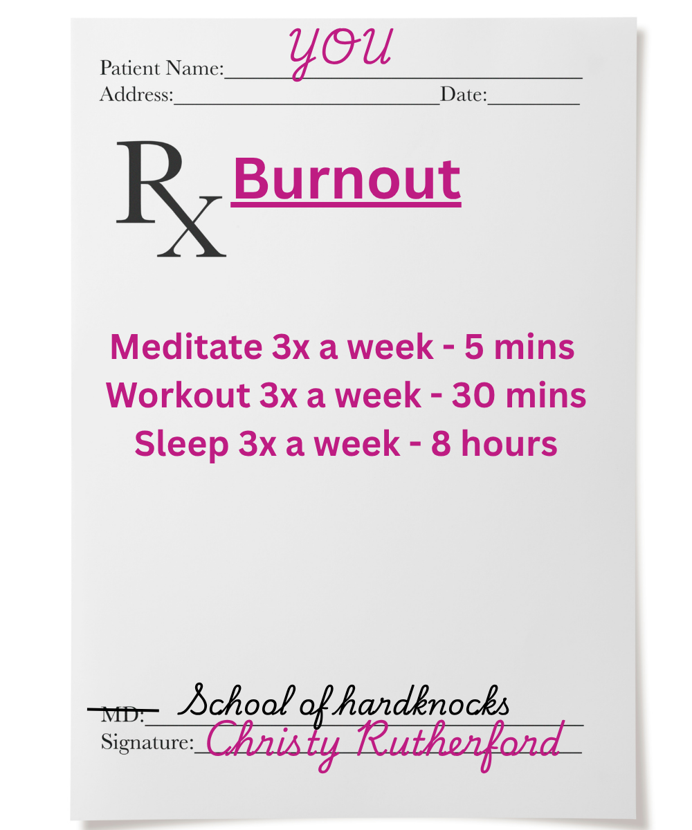
This is not optimization. It’s stabilization.
These habits are free, but if you resist them, pay attention. Resistance is information. High performers struggle to slow down without guilt because their bodies are addicted to stress chemicals like adrenaline and cortisol.
Slowing down will feel uncomfortable at first. That doesn’t mean it’s wrong. It means your system is relearning safety.
Action 2: Stop Numbing to Cope
If you need alcohol, distractions, or constant stimulation to get through the day, your system is overloaded. Numbing delays recovery by muting the signals meant to protect you. Remove the numbing long enough to hear what your body has been saying for years.
This is not about judgment. It’s about honesty.
Action 3: Treat Recovery as a Lifestyle, Not a Phase
Burnout recovery isn’t a break; it’s a recalibration. Once you’re stable, then you can examine what’s really driving the fire. Who’s holding the match? Often it’s you—attached to habits of over-responsibility, self-neglect, and constant pressure.
Until your nervous system settles, those insights are inaccessible.
Retraining Yourself to Feel Safe Again
When you’ve lived in fight-or-flight for years, peace feels unfamiliar. Your body has learned to exist on stress. Recovery means retraining yourself to feel calm, focused, joyful, and clear again and practicing those states until they become normal.
This is possible! I know because I’ve lived it and because I’ve seen it work for hundreds of leaders across industries, countries, and backgrounds. The question isn’t whether recovery works. The question is whether you’re willing to stop surviving long enough to heal.
A Final Question
John 5:6 - When Jesus saw him lying there, and knew that he already had been in that condition a long time, He said to him, “Do you want to be made well?”
Do you want to be whole, or do you just want things around you to change?
In these times of normalized chaos, burnout recovery requires urgency without shame, responsibility without self-attack, and the courage to stop confusing endurance with excellence.
Give yourself 90 days. Your clarity, health, and leadership depend on it.
Get my latest book, "90 Days to Burnout Recovery" and learn the exact steps I took to recover from a full mental and physical collapse. We move past breathing to learning how to draw boundaries and forgive your family. That's The Work that will give you a peace that surpasses understanding. Get it on Amazon HERE.
Which of the three habits are you going to commit to this week?
Meditation, sleep, or working out. Let me know in the comments.




Responses